



Something strange is happening to our inner sense of time.
Many people describe feeling as if they’re constantly in a rush. They feel the need to hurry through whatever task is before them. Maybe you’ve noticed it too – skimming messages, juggling tasks, clicking between tabs, or trying—unsuccessfully—to complete one thing before three others claim your attention.
This is not a personal failing. It’s not even a sign of stress in the traditional sense.
It is the predictable result of a modern environment that overwhelms the brain’s attentional system, fragments focus, and reshapes our subjective experience of time.
In this article, we’ll look closely at how this inner rushing develops, why it’s increasingly common, what neuroscience reveals about the way attention shapes our perception of time, and why self-hypnosis is one of the most powerful methods for restoring depth, clarity, and mental steadiness.
The Fractured Attention of Modern Life
We live in the attention economy—an environment where companies compete to capture and keep your focus. Every notification, banner, vibration, headline, and autoplay feature is designed to pull your awareness toward it.
The problem is simple, but profound:
Your brain can only fully attend to one thing at a time.
When we try to multitask, what actually happens is rapid task switching. Neuroscientists like Dr. Daniel Levitin have shown that switching tasks floods the brain with stress hormones and burns up glucose—the fuel your neurons rely on—faster than sustained focus does. This creates mental fatigue and a subtle sense of urgency.
Each switch requires the brain to drop context, load new context, reorient goals, and suppress distractions. This isn’t instantaneous; it merely feels instantaneous because it happens just below conscious awareness.
Do this a few times per hour and you barely notice it.
Do it hundreds of times per day—and you begin to feel that life itself is speeding up.
Not because more is happening… but because you’re experiencing tiny, constant accelerations in your internal rhythm.
A Useful Metaphor: Skimming the Surface
Imagine gliding quickly across the surface of an ocean. You cover a lot of distance, but you never feel the depth beneath you. Depth requires slowing down, descending, and staying with one environment long enough for your senses to adapt.
And yet modern life moves us horizontally—fast, shallow, wide.
Attention switching creates the same effect inside the mind: an experience of speed without the satisfaction of depth.
People often report reaching the end of the day having “done a lot” but feeling oddly incomplete, as if nothing fully landed. This is not a failure of productivity. It is a failure of opportunity—the opportunity to immerse attention deeply enough for the nervous system to register completion.
The Neuroscientist’s Perspective: Your Brain Wasn’t Designed for Simultaneity
In the past two decades, the volume, speed, and simultaneity of incoming information has exploded far beyond what the human brain was originally designed to process.
Cognitive neuroscientist Earl Miller has demonstrated that the brain simply cannot process multiple streams of information consciously at once. It flicks rapidly between them—each flick producing cognitive strain and reinforcing the habit of fragmentation.
So even if you think you’re calmly handling your day, your nervous system may be in a state of constant micro-activation.
Those micro-activations add up.
They give rise to the familiar sensation of rushing, even when you’re physically still.
The Psychologist’s Perspective: The Arrival Fallacy
Psychologists describe “arrival fallacy” as the belief that once you finish everything, you’ll finally get to relax. Many people structure their entire day around this hope.
But tasks regenerate faster than we complete them.
So instead of finding rest, the nervous system remains in low-level forward motion—leaning ahead mentally, anticipating the next item, believing relief is somewhere just beyond the present moment.
In this mindset, even periods of stillness feel agitated, because the body has learned that stopping is unsafe or unrealistic until everything is done.
Of course, “everything” is never done.
The Philosopher’s Perspective: Why Ancient Wisdom Still Applies
Long before neuroscience existed, the Stoic philosopher Seneca wrote extensively about the human relationship to time and attention. Living in ancient Rome, he observed a pattern strikingly familiar today: people feeling hurried, scattered, and internally stretched thin.
In his essay On the Shortness of Life, Seneca wrote, “It is not that we have a short time to live, but that we waste much of it.” His point wasn’t moralistic — it was observational. He noticed that when people divide their attention, they lose the experience of depth. Time feels depleted not because life is brief, but because attention is diluted.
Seneca’s insight aligns closely with modern psychological research. What he noticed intuitively, neuroscience now explains with precision: when attention is scattered, life feels faster and more chaotic. When attention is concentrated, time feels fuller and more abundant.
This connection leads us to an important idea — one that cognitive scientists have studied directly.
The Evidence Behind: “Attention Creates Psychological Time”
Psychological time—the felt sense of how long or full a moment is—depends heavily on two factors:
- Attentional engagement
- Encoding depth in memory
Studies by neuroscientist David Eagleman show that when we pay closer attention to sensory details, time feels slower and richer. Novel or deeply engaging experiences are stored with more neurological detail, so they appear “longer” in memory.
By contrast, when attention is fragmented, events are encoded shallowly. The brain stores fewer details. As a result, large stretches of the day compress into a blur.
This is why vacations feel long and busy workweeks feel short.
It’s also why a distracted life feels fast.
Your experience of time is constructed from the density of your attention—not the ticking of a clock.
So when attention is constantly pulled, clipped, interrupted, and scattered, psychological time collapses. Life feels faster because the mind isn’t sinking deeply enough into any moment to give it weight.
Inner Rushing Is Not Just Stress — It’s a Byproduct of the Modern Age
Inner rushing often gets mislabeled as anxiety. But for many people, it’s something different:
A mismatch between the speed of incoming information and the natural tempo of human attention.
Even without emotional distress, this mismatch produces:
- A subtle internal pressure
- A feeling of being mentally “ahead” of oneself
- Difficulty transitioning into states of rest
- A lack of satisfaction after completing tasks
- A weakened sense of presence
What’s remarkable is that people often assume the solution is to “get organized,” “try harder,” or “be more disciplined.”
But the real issue isn’t effort—it’s rhythm. The rhythm of attention has been disrupted.
And rhythm can be retrained.
This Is Where Self-Hypnosis Becomes Incredibly Valuable
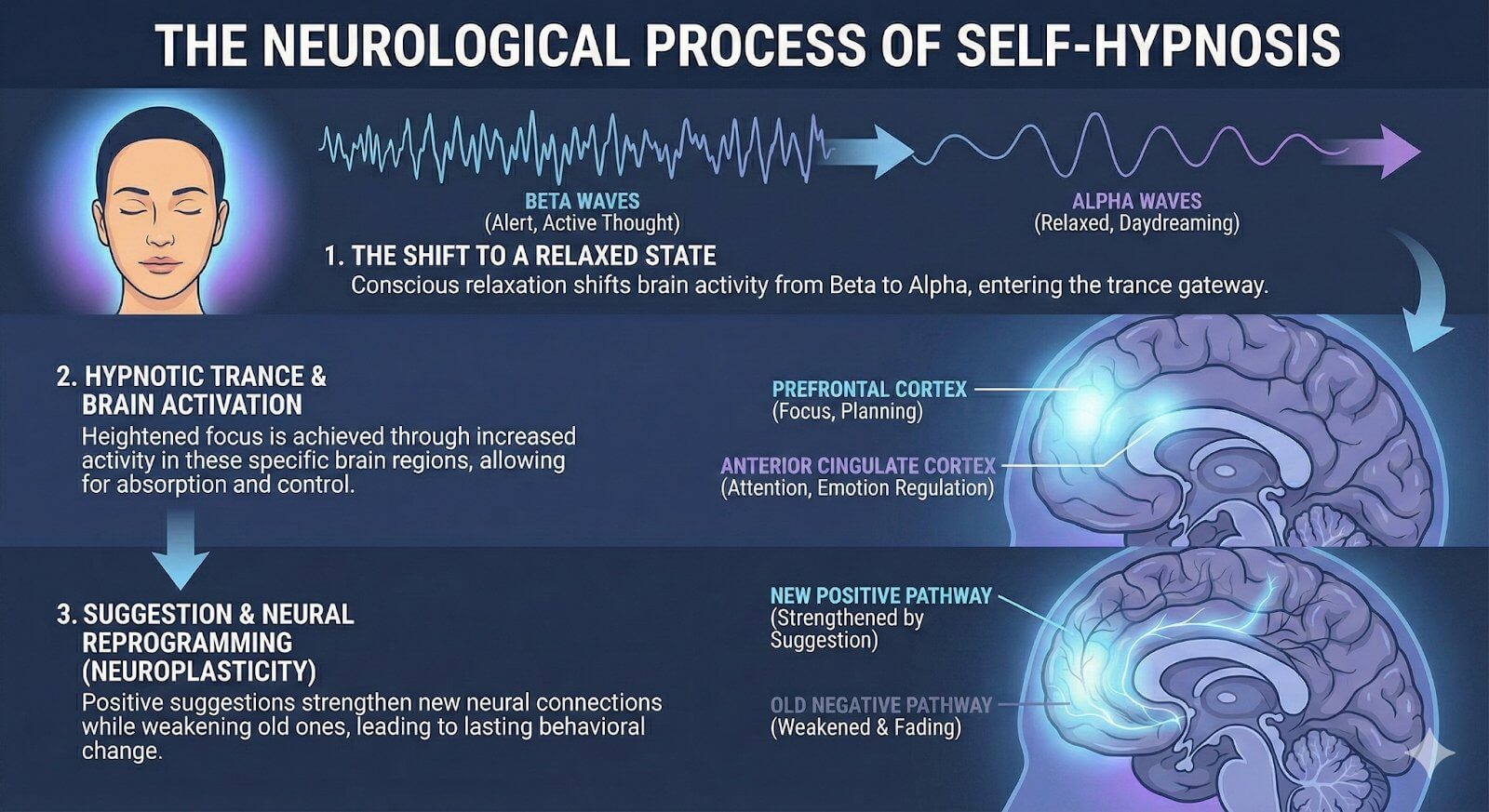
Self-hypnosis is often misunderstood as a simple relaxation technique. In reality, it is a sophisticated process of attentional retraining. It gives the mind structured experiences of depth, stillness, and sustained focus—the very qualities modern life erodes.
To appreciate why self-hypnosis is so effective, it helps to understand that hypnosis is not an escape from the world’s noise; it is the intentional cultivation of a different internal rhythm. A rhythm that allows attention to sink, settle, and stabilize.
Self-hypnosis interrupts the habitual switching that drives inner rushing, and instead invites the mind into singularity—a state in which one experience becomes the full, rich center of awareness.
Below is a deeper look at the mechanisms that make it uniquely powerful.
Self-Hypnosis Reduces Default Mode Activity
The default mode network (DMN) is the neural system active during mind-wandering, rumination, self-focused thinking, and background mental commentary. It is heavily involved in the sense of being mentally “elsewhere” — thinking about the past, anticipating the future, or drifting toward unfinished tasks.
Studies using fMRI and EEG have repeatedly shown that hypnotic states reduce activity in the DMN. When DMN activation quiets:
- Background chatter settles
- The sense of mental pressure decreases
- Attention becomes steadier and less reactive
- The mind shifts from narrative thinking into experiential awareness
This reduction in DMN activity is one of the core reasons hypnosis produces such profound feelings of clarity and ease. You’re no longer running multiple internal programs simultaneously, you’re inhabiting one experience.
It Restores the Sense of Depth
One of the defining features of hypnosis—supported by decades of research—is absorption.
Absorption is a deep, immersive focus in which the mind becomes fully engaged with a specific sensation, image, or thought.
Absorption is the antidote to surface-level living.
When you enter a hypnotic state, your attention does not skate across multiple tasks. It settles, descends, and stays. Neural resources that were previously divided across competing stimuli become unified.
This allows:
- Sensory richness to return
- The mind to encode experiences more deeply
- Tasks and thoughts to feel complete rather than fragmented
Even a brief hypnotic session can reintroduce the body and brain to this feeling of depth — a state many people rarely experience in daily life anymore.
It Resets Internal Tempo
Inner rushing is often the result of a nervous system operating slightly above its optimal tempo. Self-hypnosis intervenes by shifting the autonomic nervous system toward parasympathetic dominance — the state associated with rest, digestion, recovery, and cognitive clarity.
During trance:
- Breathing naturally slows
- Muscle tension decreases
- Heart rate variability improves
- The prefrontal cortex relaxes its tight grip on executive control
- Cognitive load diminishes significantly
This creates a feeling of internal spaciousness: not sedation, but unforced calm. You are present without being pushed or pulled. You are alert without being tense.
This recalibrated tempo often lasts long after the session ends. Many people describe moving through the rest of their day with a grounded steadiness, even when the external world remains busy
It Rebuilds Your Attentional “Muscle”
Attention is trainable. Just as physical muscles strengthen through repeated use, neural circuits involved in selective focus become more robust through practice.
Every self-hypnosis session is a structured workout for the attentional system because you intentionally direct focus, sustain it, return to it when the mind wanders and deepen it through imagery, sensation, or guided suggestions.
Over time, this strengthens the brain networks responsible for concentration, inhibitory control, and cognitive quiet. This is why regular self-hypnosis often produces noticeable improvements in:
- Focus during work
- Ability to complete tasks without switching
- Emotional regulation
- Memory consolidation
- Overall mental clarity
In a world of constant distraction, this strengthened attentional capacity becomes an invaluable asset.
What makes self-hypnosis especially transformative is its cumulative nature. The benefits don’t vanish after each session — they accumulate, layer by layer, forming a new default state.
In essence, self-hypnosis helps you reclaim the full bandwidth of your attention. Instead of being pulled outward by every competing stimulus, attention becomes something you own again — something you can direct, shape, and deepen.
The Real Benefit: Reclaiming Ownership of Your Attention
Inner rushing is not inevitable. It is not permanent. It is not a personality trait.
It is a habit — one shaped by environments that fragment the mind.
Self-hypnosis offers the antidote by giving your mind the experience it has been starved of:
A moment that is undivided.
When attention settles, psychological time expands. Life slows—not externally, but internally. Depth returns. Presence strengthens. And the inner rushing that once felt unavoidable fades into something quieter, something steadier, something genuinely your own.
If you’re new to self-hypnosis the free Unleash the Power of Your Mind Training is a great place to start.
Or if you’re looking to deepen your practice, The Beyond Self Hypnosis Training is an in-depth program that will turn self-hypnosis into a life-long skill you can turn to time and time again to deepen your concentration, re-focus your attention and unlock exciting new parts of your mind you didn’t even know existed.
Find out more about self-hypnosis on this page, or reach out to our team if you have any questions – we are here to help!