


For many people who are new to hypnosis, the word itself carries a lot of baggage.
They imagine trance states, swinging watches, or someone being “controlled” against their will.
But conversational hypnosis works differently.
It happens in everyday conversations when you guide someone’s attention naturally, without them realizing anything “hypnotic” is taking place.
One of the best techniques you can start using right away? Asking the right questions at the right time.
In this article, you’ll discover how a simple conversational skill can shift how people think, reduce resistance, and open doors to new possibilities.
What Conversational Hypnosis Really Is
Conversational hypnosis refers to the use of ordinary language to guide attention, shape perception, and influence internal experience during normal conversation.
There is no formal induction. Instead, conversational hypnosis works because the human mind naturally enters focused, receptive states all the time—while listening to a story, thinking deeply, or trying to explain something important.
The psychiatrist and hypnotherapist Milton Erickson was one of the first to clearly demonstrate this. He showed that people do not need to be “put into hypnosis.” They move in and out of hypnotic states naturally, especially when their attention turns inward.
A thoughtful conversation can do exactly that, opening the mind to new possibilities, ideas and lead to subtle shifts that can have profound impacts on someone’s life.
Although Conversational Hypnosis requires deeper study to truly master, especially if you want to apply it therapeutically, you can use aspects of conversational hypnosis in your everyday interactions to have a positive impact on the people around you.
One of the best places to start is to ask better questions to shift someone’s thinking naturally.
Why Questions Matter More Than Explanations
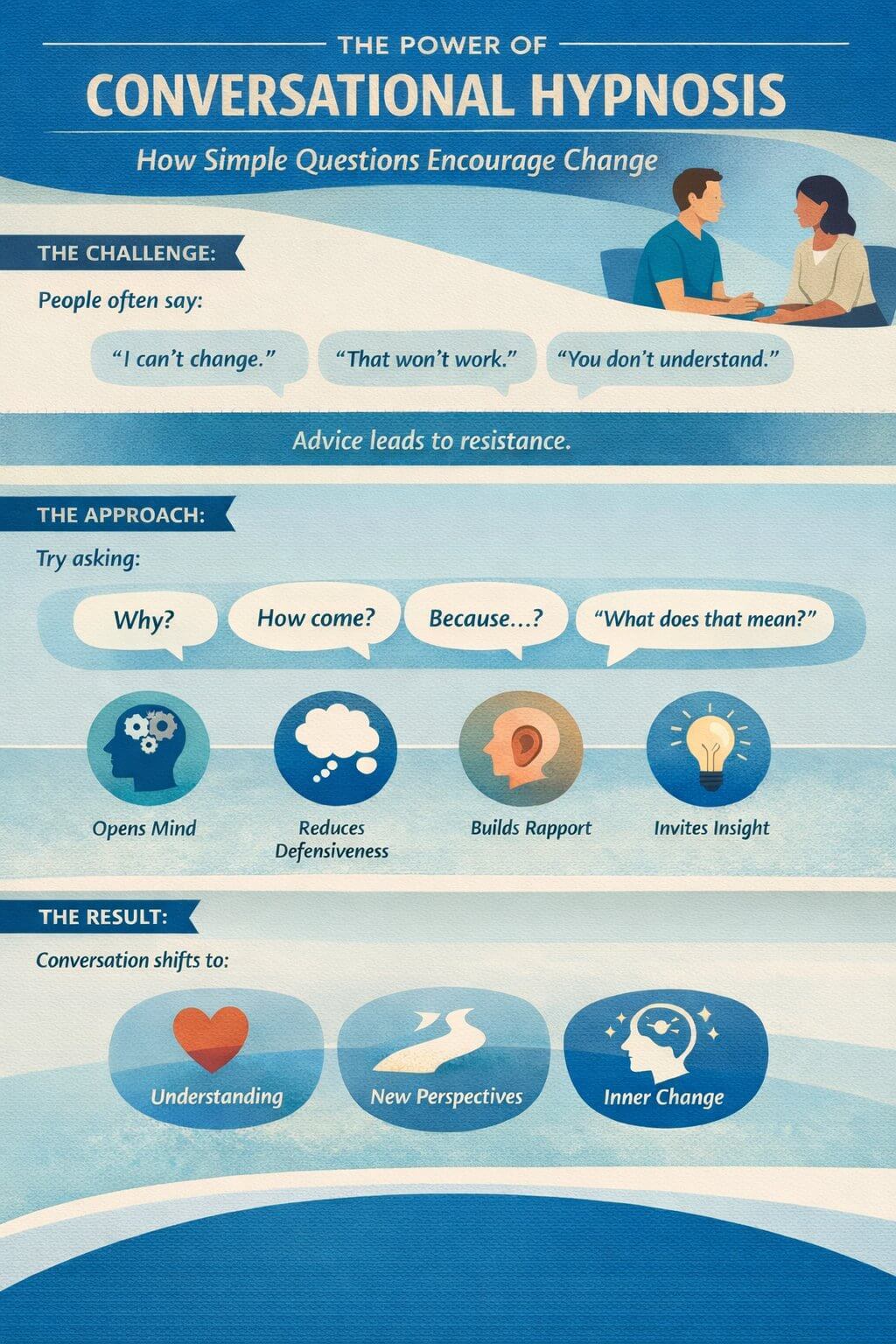
When people struggle—emotionally, professionally, or personally—they often express that struggle as a statement:
“I can’t change.”
“That won’t work.”
“It’s just how things are.”
These statements feel solid and final. But in most cases, they are not facts. They are compressed conclusions—the end result of thoughts, assumptions, and emotional experiences that are no longer visible.
When you respond to these statements with advice or explanations, something predictable happens. The person either defends their position or disengages. Not because you are wrong, but because the frame has not changed.
Questions work differently.
A well-chosen question invites the mind to open the box again.
Instead of pushing against a belief, it encourages the person to explore how that belief was formed in the first place.
This is one of the foundations of conversational hypnosis.
A Foundational Technique: Leading Questions
One of the simplest conversational hypnosis skills you can master is deliberately simple. It does not rely on advanced hypnotic language or psychological theory.
It relies on asking questions that keep the conversation moving rather than shutting it down.
There are four types of questions that are especially useful:
- Why
- How come
- Because…?
- What does that mean?
Used correctly, these questions do not interrogate or challenge. They invite elaboration.
When someone elaborates, they slow down. When they slow down, attention turns inward. And when attention turns inward, change becomes possible.
What Happens in the Mind When These Questions Are Asked
From the outside, nothing dramatic seems to happen. The conversation simply continues.
Internally, something important shifts.
A statement like “I can’t do that” is usually held together by vague assumptions. When asked, “How come?”, the mind must begin searching for reasons. Often, those reasons are incomplete, outdated, or emotionally charged rather than factual.
This process gently loosens certainty.
Instead of arguing with the conclusion, the question leads the person back into the process of thinking. That process is where flexibility lives.
This is one of the reasons conversational hypnosis feels respectful rather than manipulative. You are not telling someone what to think. You are helping them hear their own thinking more clearly.
How To Ask Better Questions In Everyday Interactions
To understand how practical this is, consider a few ordinary situations.
A friend says, “You don’t understand what I’m dealing with.”
A defensive response might try to explain or reassure. A more hypnotic response might simply ask, “What does that mean for you?”
Now the focus shifts. Instead of defending your understanding, you are inviting them to describe their experience. Attention moves inward. Emotional intensity often softens.
Or imagine a work setting where a colleague says, “This project is going to fail.”
Instead of debating outcomes, asking “How come?” opens space. The answer may reveal concerns about time, resources, or communication—specific issues that can actually be addressed.
Even internally, this approach works.
The next time you catch yourself thinking, “I’m just not good at this,” pausing to ask “Why?” or “Because…?” often exposes how thin the belief really is.
How Questions Naturally Create Hypnotic States
Hypnosis, at its core, involves three elements: focused attention, reduced mental noise, and increased responsiveness to internal experience.
Leading questions naturally produce all three:
They focus attention on meaning rather than reaction.
They slow the conversation, reducing emotional escalation.
They guide awareness inward and stimulate the unconscious mind.
None of this requires trance – only presence and timing.
This is why conversational hypnosis is often taught as a foundation rather than an advanced skill. Without it, more complex hypnotic techniques tend to feel forced or artificial.
The best part?
You do not need to practice this in a formal way. In fact, it works best when it feels natural.
The next time a conversation feels tense or stuck, resist the urge to explain or fix. Instead, choose one gentle question and ask it sincerely. Then listen.
That pause—the space created by the question—is where change begins.
With time, you may notice something interesting. Conversations become calmer. People feel more understood. And you find yourself less reactive, because you are no longer trying to carry the conversation forward on your own.
A First Step Into Conversational Hypnosis
For people who are new to hypnosis, conversational techniques like this are often the most approachable entry point. They demonstrate that hypnosis is not mysterious or extreme. It is rooted in how humans naturally communicate and make sense of their experience.
Understanding this changes how you listen, speak and how you relate to others, and even to yourself.
If you want to take the next step to expand your conversational hypnosis skills, the <l>Free Hypnotic Language Shortcut System Card Deck</l> is a great place to start.
Each card contains specific words woven into powerful phrases you can use immediately.
And each card also comes with examples so you can quickly understand how to use them when you’re speaking or writing.
Ready to go even deeper? You can find the complete first edition of the Conversational Hypnosis Professional Hypnotherapy Training available for free on YouTube.
So go ahead and start with one question in your next conversation, and notice what shifts. You might be surprised!