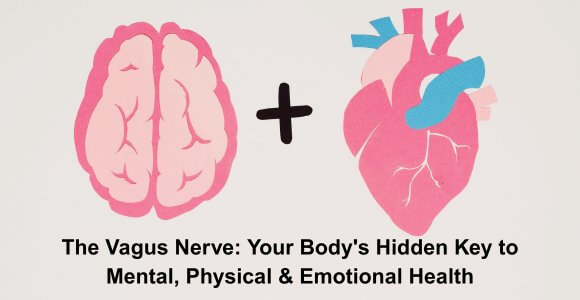
Have you ever set a clear goal, known exactly what you needed to do, and then watched yourself do… nothing? Or felt your stomach knot before a conversation your rational mind insisted was no big deal? Or tried to “think your way” out of anxiety, only to find the feeling completely ignored your logic?
If so, you’re not weak, lazy, or broken. You’re experiencing a breakdown in communication between your brain and your body — and that conversation runs along a single, trainable cable called the vagus nerve.
Learn how this remarkable nerve works, and you’ll see exactly why something as simple as how you breathe — and a tool as powerful as self-hypnosis — can change how you think, feel, and perform. So let’s start at the source.
What exactly is the vagus nerve?
The vagus nerve is the longest of your twelve cranial nerves. Its name comes from the Latin word for “wandering,” and that’s precisely what it does: it leaves the base of your brain, travels down through your throat and chest, branches out to your heart and lungs, and ends deep in your gut. (You actually have two — one running down each side of your body.)
Think of it as the main communication line between your brain and your internal organs. It’s also the central component of your parasympathetic nervous system — the “rest and digest” branch that slows your heart rate, supports digestion, and switches off the stress response. Its everyday jobs include:
- Regulating your heart rate and blood pressure
- Controlling digestion, plus the muscles you use to swallow and speak
- Managing your breathing and your relaxation response
- Carrying sensory information from your organs back up to your brain
That last job may be surprising. Most of us assume nerves run in a single direction — the brain decides, the body obeys. The vagus nerve overturns that idea. Research shows that roughly 80% of its fibres are afferent, meaning they carry information up from the body to the brain, not down. Your body, in other words, is doing far more “talking” than “listening.”
This is the cable your intuition travels along. Those gut feelings, that flutter of dread, that sense that “something’s off” before you can explain why — much of it arrives via the vagus nerve, relaying the real-time state of your organs to your brain. Which raises a bigger question: if your body has that much to say, where is all that information coming from?
You have more than one “brain”
The answer is that, in a very real sense, you have intelligence in more than one place — and the vagus nerve is what connects those places together.
The brain in your gut. Lining your digestive tract is the enteric nervous system, a network so dense and capable that scientists call it the “second brain.” It contains more than 500 million neurons — and it can operate largely independently of the brain in your skull, running digestion on its own. It’s also where the majority of your body’s serotonin, a key mood-regulating chemical, is produced. This is why a “nervous stomach” before a big moment isn’t just a figure of speech. Your gut is genuinely reacting to the situation. And it tends to be the part of you most tied to action — which is why, when you feel disconnected from it, starting things and sustaining momentum can feel impossibly heavy.
The brain in your heart. Your heart isn’t only a pump. In 1991, neuroscientist Dr. J. Andrew Armour identified what’s now called the intrinsic cardiac nervous system — a cluster of about 40,000 neurons embedded in the heart itself, often nicknamed the heart’s “little brain.” It can sense, process, and respond to information, and it’s in constant dialogue with the head-brain through (you guessed it) the vagus nerve. The old poetry about the heart being the seat of feeling turns out to have a grain of physiology behind it.
You don’t need to memorise any of this. The takeaway is simple: thinking, feeling, and doing aren’t housed in one tidy box at the top of your spine. They’re distributed across a body-wide system, linked by the vagus nerve — and the quality of your life depends on how well those parts are talking to each other.
Why this runs your everyday life
When your head, heart, and gut are in sync, you feel it as coherence. You can set a goal, feel motivated to pursue it, and actually take action. Your emotions stay regulated. Your stress response fires only when it’s genuinely needed.
When they’re out of sync — usually because you’re stuck in chronic low-grade stress, with the “fight or flight” sympathetic system running the show — the symptoms are exactly the ones so many of us live with. Foggy thinking. Restless anxiety. Trouble starting or finishing anything. A feeling of being at war with yourself.
One useful, measurable window into this balance is heart rate variability (HRV): the subtle, healthy variation in the time between your heartbeats. Higher HRV is generally a sign of strong vagal tone and a flexible, resilient nervous system, while consistently low HRV is associated with stress and poorer recovery.
Signs Your Vagal Tone May Need Attention
Because the vagus nerve touches so many systems, low vagal tone tends to show up as a cluster of seemingly unrelated symptoms. Some common signs include:
- Persistent low-level anxiety without an obvious cause
- Difficulty relaxing fully, even after rest
- Digestive issues — bloating, irregularity, sensitivity
- A tendency to feel emotionally flat or disconnected
- Poor recovery from stress — things take longer to feel okay again
- Brain fog or difficulty concentrating
- A sense of going through the motions without real motivation or drive
- Feeling socially drained rather than energised by connection with others
None of these on their own are definitive — they can have many causes. But if several resonate, it’s worth paying attention to what your nervous system might be telling you.
The encouraging part? Vagal tone isn’t fixed. You can train it.
The simplest lever you already own: your breath
Of all the ways to send a calming signal down the vagus nerve, the most immediate is also the most overlooked. Your breath.
Watch anyone who’s panicking and you’ll see fast, shallow, ragged breathing. Watch someone deeply relaxed and you’ll see something slower and more even. Breath rhythm isn’t just a symptom of your state — it’s one of the few levers that lets you reach in and change it.
The rhythm that does the most to harmonise the system is slow, smooth breathing in which the inhale and exhale are roughly equal in length and a little longer than usual.
Studies on what researchers call slow-paced or resonance-frequency breathing — typically around six breaths per minute — show that it raises heart rate variability and shifts the body toward parasympathetic dominance. A broad review of breathwork research found that slow, nasal, diaphragmatic breathing reliably improved vagal tone and emotional control while lowering the stress hormone cortisol.
Here’s a way to practise it that takes about two minutes:
- Sit comfortably and let your gaze soften, or close your eyes.
- Don’t force your breathing. Instead, simply rest your attention on it, the way you’d watch waves roll in and out.
- Gently let the breath slow and settle until your in-breath and out-breath feel about equal, each lasting a slow count of around five.
- When your mind wanders, that’s fine — just bring your attention back. The attention itself is what trains the rhythm.
The aim is to make this a calm, balanced rhythm so familiar that it becomes your default — the baseline your body returns to on its own, freeing you to dial the energy up when you need drive and down when you need rest.
Some other most well-supported natural approaches to tone your vagus nerve include:
- Cold water exposure — even briefly splashing cold water on the face is thought to stimulate the vagus nerve through the diving reflex, though the evidence here is more preliminary than for breathwork.
- Humming, chanting, or singing — the vagus nerve innervates the muscles of the throat and larynx, so these activities create direct physical stimulation along the nerve.
- Meditation and mindfulness — regular practice is associated with improved parasympathetic activity and HRV, though results across studies vary depending on the type of meditation and how it’s measured.
- Gentle physical movement — walking, yoga, and swimming all support nervous system regulation and autonomic balance.
- Genuine social connection — relaxed, safe connection with others is associated with improved vagal tone through the social engagement system.
All of these work. But there’s one practice that combines almost everything on this list — slow rhythmic breathing, inward attention, deep relaxation, and direct access to the unconscious mind — in a single, repeatable daily tool.
That practice is self-hypnosis.
Why Self-Hypnosis Is One of the Most Powerful Vagal Toning Tools Available
Self-hypnosis is a state of focused inner attention — a way of deliberately shifting the mind and body out of the ordinary alert state and into a deeply relaxed, receptive one.
To enter that state, you guide yourself into slow, rhythmic breathing. Your body stills. External noise fades. Heart rate settles. Muscle tension releases. And as that happens, something important occurs: your vagus nerve activates, the parasympathetic system takes over, and all three of your brain centers — head, heart, and gut — begin to come into alignment.
This is not a side effect of self-hypnosis. It’s at the heart of what makes it work.
The slow, rhythmic breathing at the core of most self-hypnosis inductions is the same breathing pattern that research identifies as most effective for vagal activation — a finding from the neuroscience of contemplative practice that hypnotherapists have been applying intuitively for decades.
In a hypnotic state, the body’s stress response quiets and the unconscious mind becomes more accessible. This is the state in which new habits take root most easily, limiting beliefs lose their grip, and the relationship between mind and body becomes something you can actively work with rather than just observe.
Studies using heart rate variability have found that hypnosis tends to shift autonomic balance toward parasympathetic activity while reducing sympathetic arousal — the very “rest and reset” state that good vagal tone supports.
Clinically, this is why hypnotherapy is used for conditions rooted in an overactive stress response, from chronic pain and anxiety to gut-directed hypnotherapy for irritable bowel syndrome, which works directly on the brain–gut axis.
Regular self-hypnosis practice essentially trains your nervous system to access this regulated state more easily — which means your baseline vagal tone improves over time. The benefits compound. What starts as a deliberate daily practice gradually becomes a more stable, resilient nervous system state.
For people dealing with anxiety, this matters enormously. For those navigating burnout, grief, or chronic stress, it matters just as much. And for anyone wanting to function at a higher level — more clear, more present, more purposeful — it’s one of the most underused tools available.
You can watch a detailed video of Master Hypnotist Igor Ledochowski explaining how to hypnotize yourself here:
A Simple Starting Practice
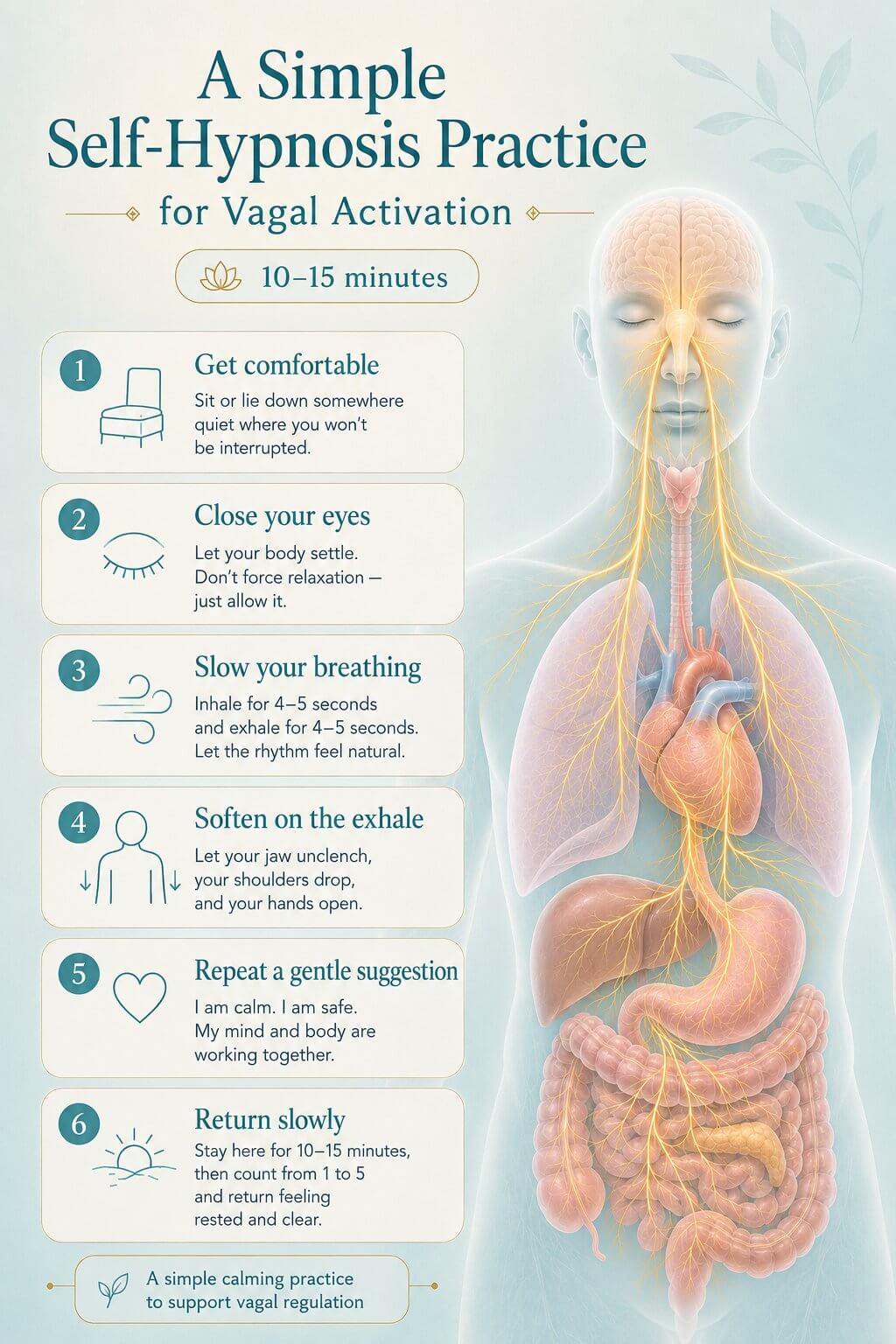
Here’s a straightforward approach to a short self-hypnosis session built around vagal activation:
- Find a comfortable position — seated or lying down, somewhere you won’t be interrupted for 10–15 minutes.
- Close your eyes and let your body settle. Don’t try to force relaxation — just allow it. Notice the weight of your body against the chair or floor.
- Begin to slow your breathing. Aim for an inhale and exhale of roughly equal length — about 4–5 seconds each. Don’t strain. Let the rhythm find itself.
- With each exhale, allow your body to soften a little more. Let your jaw unclench, your shoulders drop, your hands open.
- As you settle into the rhythm, introduce a simple suggestion. Something like: “I am calm. I am safe. My mind and body are working together.” Repeat it gently, without effort.
- Stay in this state for 10–15 minutes. When you’re ready, count slowly from one to five, and allow yourself to return to full wakefulness feeling rested and clear.
Done consistently — even once a day — this kind of practice has a measurable effect on nervous system regulation. Over weeks and months, many people notice changes not just in how they feel during the practice, but in how they handle stress, process emotions, and experience their daily lives.
Bringing your three brains into the same room
You may have come into this thinking your problem was discipline, or focus, or willpower. More often, it’s communication — a head, a heart, and a gut that have stopped working as a team.
The vagus nerve is the line that connects them, your breath is the simplest way to send a calming signal down it, and self-hypnosis is how you take conscious control of the whole exchange.
Start small. Two minutes of slow, even breathing today. Notice what shifts. Then, when you’re ready to go further — to learn how to guide your mind into that focused, receptive state on demand and use it to reach your actual goals — that’s exactly what self-hypnosis is built for.
If you’re new to self-hypnosis and ready to experience its incredible benefits for yourself then the Power of Self Hypnosis Training Program will give you a step-by-step method for easily hypnotizing yourself, connect your unconscious to get what you truly desire and unlock the power of your mind. Find out more here:






![Yogic Breathing For Hypnosis: 3 Easy Techniques To Ground & Relax Your Clients Before Inducing A Hypnotic Trance [Includes Infographic]](https://hypnosistrainingacademy.com/wp-content/uploads/2019/05/yogic-breathing-for-hypnosis.jpg "Yogic Breathing For Hypnosis: 3 Easy Techniques To Ground & Relax Your Clients Before Inducing A Hypnotic Trance [Includes Infographic]")

![[ADVANCED GUIDE] How To Master Hypnotic Regression Therapy - Part I: Essential Principles To Profoundly Transform Your Subject’s Emotional Trauma](https://hypnosistrainingacademy.com/wp-content/uploads/2016/09/hypnotic-regression-therapy-essential-principles.jpg "[ADVANCED GUIDE] How To Master Hypnotic Regression Therapy - Part I: Essential Principles To Profoundly Transform Your Subject’s Emotional Trauma")